- Deutsch
- English
- Nederlands
- Español
- Français
- Texts were edited with AI


Laboratory testing ranging from DIN EN to KNVB to FIFA
Testing Services for Synthetic Turf Systems and Individual Components
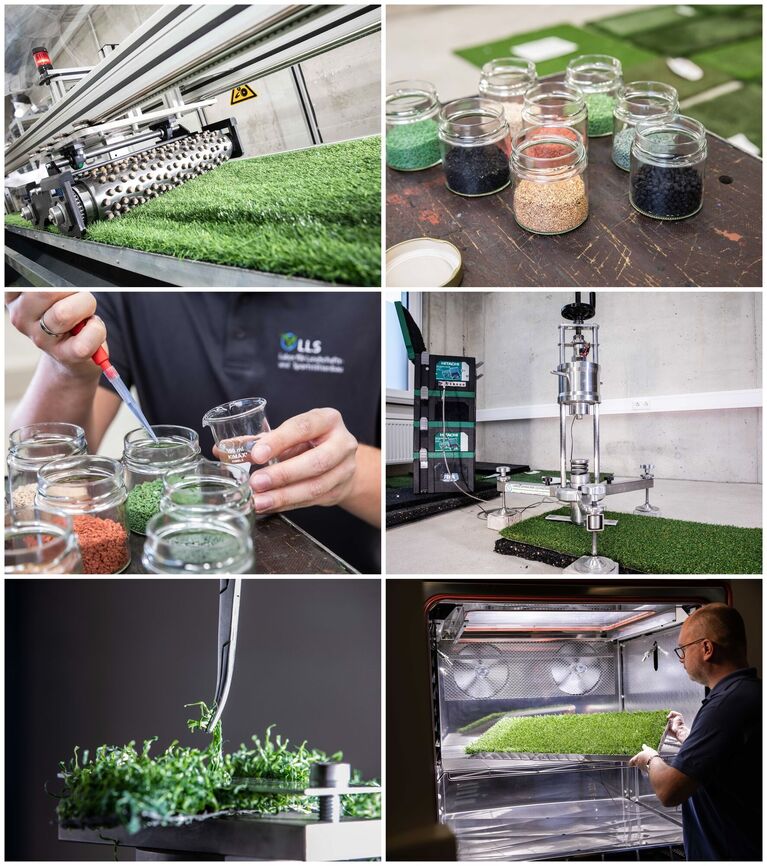
As an ISO 17025-accredited and certified testing laboratory, LLS offers a portfolio of testing services for a wide variety of synthetic turf systems that is unique in Europe - for use ranging from local leagues to the Champions League.
System Testing - It’s All About How the Parts Work Together
In addition to individual components, we test the entire system for its performance and safety-related properties:
- Ball behavior: Ball rolling resistance and bounce (rebound) compared to the reference values for natural turf in good condition
- Torsional resistance: Resistance to twisting between the shoe and the surface to prevent joint injuries
- Force dissipation and shock absorption: Protective function of the entire system design
- Wear and aging simulation: mechanical stress on the surface to predict service life under real playing conditions
Component Testing – Every Layer in Detail
A synthetic turf system is only as good as its weakest component. That is why we specifically test each individual layer for its technical properties:
- Fibers: e.g., pile height, UV resistance, DSC, IR, tuft thickness, fiber cross-section, yarn weight, and tuft withdrawal force - the latter is a key factor in determining the turf’s longevity
- Backing coating: Tensile strength, water permeability, and bond strength between fibers and the backing material
- Elastic layer/shock pad: Tensile strength, water infiltration, or shock absorption capacity (force dissipation), which are crucial for player safety and joint protection
- Filler materials (sand, rubber granules, cork, etc.): particle size, bulk density, and environmental compatibility
- Unbound base layer: Water permeability and shear strength as the foundation for stability and drainage
Sunlight and Climate Simulation
Synthetic turf systems and their components are exposed to UV radiation, temperature fluctuations, and weather conditions over many years. In our sun and climate simulation, we test color fastness, material aging, and embrittlement to make realistic assessments of durability under outdoor conditions.
Standards We Use for Testing
Depending on the application, we test components and systems in accordance with, among others:
- FIFA TM2015 & TM2024 (Artificial Turf Test Manual)
- KNVB Guidelines
- RAL GZ-944 (Quality Assurance for Synthetic Turf Systems)
- DIN 18035-7 (Sports Fields – Synthetic Turf Systems, Complete Construction Including Elastic Layer and Subbase)
- DIN EN 15330-1 (Synthetic Turf Surfaces for Soccer, Hockey, Rugby, Tennis, and Multipurpose Surfaces)
- DIN EN 15330-2 (Needle-punched felt surfaces for tennis and multipurpose areas)
- EN 15330-4, EN 15330-5, DIN EN 15330-6 (Additional Areas of Application and Test Methods)
RAL GZ-944 Certification
As a recognized testing laboratory, LLS offers comprehensive services related to RAL quality assurance for synthetic turf systems and their components - from initial testing to ongoing third-party monitoring - so that manufacturers and operators can demonstrate compliance with quality requirements at all times.
Environmental
Sustainability of Synthetic Turf Systems
In addition to playing characteristics and safety, environmental compatibility is a key component in the testing of synthetic turf systems - both for water and soil protection and for the health of users. As an accredited testing laboratory, we examine all relevant system components for this purpose:
- turf fibers, backing coatings, and infill materials for potential contaminant levels, including heavy metals and polycyclic aromatic hydrocarbons (PAHs)
- elastic layers and bound elastic base layers for their leaching behavior using an elution test
- Leaching behavior (elution) of the materials used to assess potential contamination of soil and seepage water
Our tests are
based on the relevant standards:
- DIN 18035-7, Annex B – Environmental Recommendations for Synthetic Turf Systems (formerly “Environmental Compatibility”)
- RAL GZ-944 – Consideration of environmental criteria within the framework of quality assurance
The analyzed parameters are compared with the environmental recommendations specified in the standards, so that manufacturers and operators receive reliable evidence of the responsible use of their synthetic turf systems.