- Deutsch
- English
- Nederlands
- Español
- Français
- Texts were edited with AI


KI-bearbeitet
Equestrian Arena Construction & Equestrian Arena Inspections
Quality and Safety Tested from the Ground Up
A good riding surface doesn’t start with the top layer. It is the interaction of the subsoil, drainage, base layer, separation layer, and top layer that ensures a riding arena functions reliably over the long term and achieves the desired performance and safety characteristics.
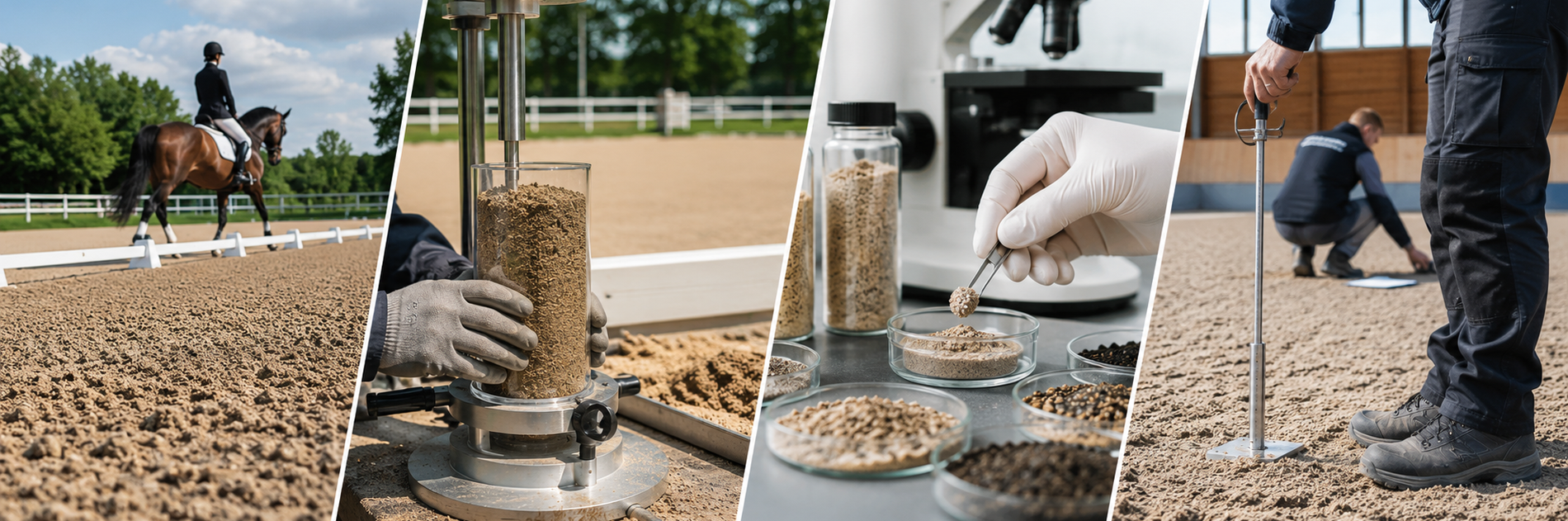
Labor Lehmacher | Schneider supports the construction, renovation, and assessment of riding arenas - from the initial subgrade investigation through material and laboratory testing to the inspection and acceptance testing of the completed facility.
Our investigations are based in particular on the FLL Riding Arena Recommendations - guidelines for the planning, construction, and maintenance of riding arenas in their currently valid version - as well as on the relevant technical standards for the individual materials and testing methods.
One point of contact. Laboratory and field. Everything from a single source.
Request a riding arena inspection
We consider the entire riding arena structure
The quality of a riding arena cannot be assessed solely on the basis of its visible surface.
Even the properties of the existing subgrade can have a decisive influence on the riding arena’s load-bearing capacity, drainage, and long-term functionality. Building on this, the individual layers must be technically and functionally coordinated with one another.
That’s why we examine not only the finished riding surface but, if necessary, the entire riding arena structure.
01 – Subgrade Investigation
The foundation for a riding arena that functions reliably over the long term
Even before construction begins, we examine the existing subgrade and determine the properties relevant to planning and execution.
Depending on the specific requirements, we examine, for example:
- Soil type and composition
- Grain size distribution
- Water content
- Water permeability
- Compaction and bearing capacity properties
- Other soil mechanical properties
Based on the test results, it is possible to assess the requirements for the further construction of the riding arena.
02 – Testing of Base and Filter Layers
Function begins beneath the riding surface
Base, filter, and, if necessary, separation layers perform important functions within the riding arena system.
We test the materials used in the laboratory and, if necessary, verify relevant properties directly on-site.
This includes, for example, tests of:
- Grain size distribution
- Grain composition
- Water permeability
- Compaction
- Bearing capacity
- Layer Thicknesses
- Flatness
- Slope
This allows you to determine, either before or during installation, whether the intended materials are suitable for the planned riding arena construction.
03 – Testing the Tread Layer
Crucial for horses and riders
The footing layer is the area of direct contact between the horse and the riding surface. Its properties influence, among other things, slip resistance, shear strength, elasticity, compression behavior, and water management.
Depending on usage and construction method, different footing layers are used - for example, made of sand, sand mixtures, or materials with aggregates.
We test surface layer materials in our laboratory before installation.
This allows us to identify unsuitable materials or material compositions before they are installed across the entire surface.
Our Tests on Surface Layers
Depending on the material and the specific requirements, we test, among other things:
- Grain size distribution
- Grain shape and material composition
- Fine-grained content
- Water content
- Water permeability
- Physical Properties of the Base Course
- Composition and Properties of Aggregates
- Compaction strength
- Penetration behavior
- Additional sports and protective properties
The results are technically evaluated based on the respective requirements and the intended use.
Tread resistance of riding arena surfaces
Objective Assessment Instead of Subjective Impression
“Too deep,” “too hard,” “too loose,” or “too dull” - in practice, the assessment of a riding surface is often based on the subjective impressions of riders and operators.
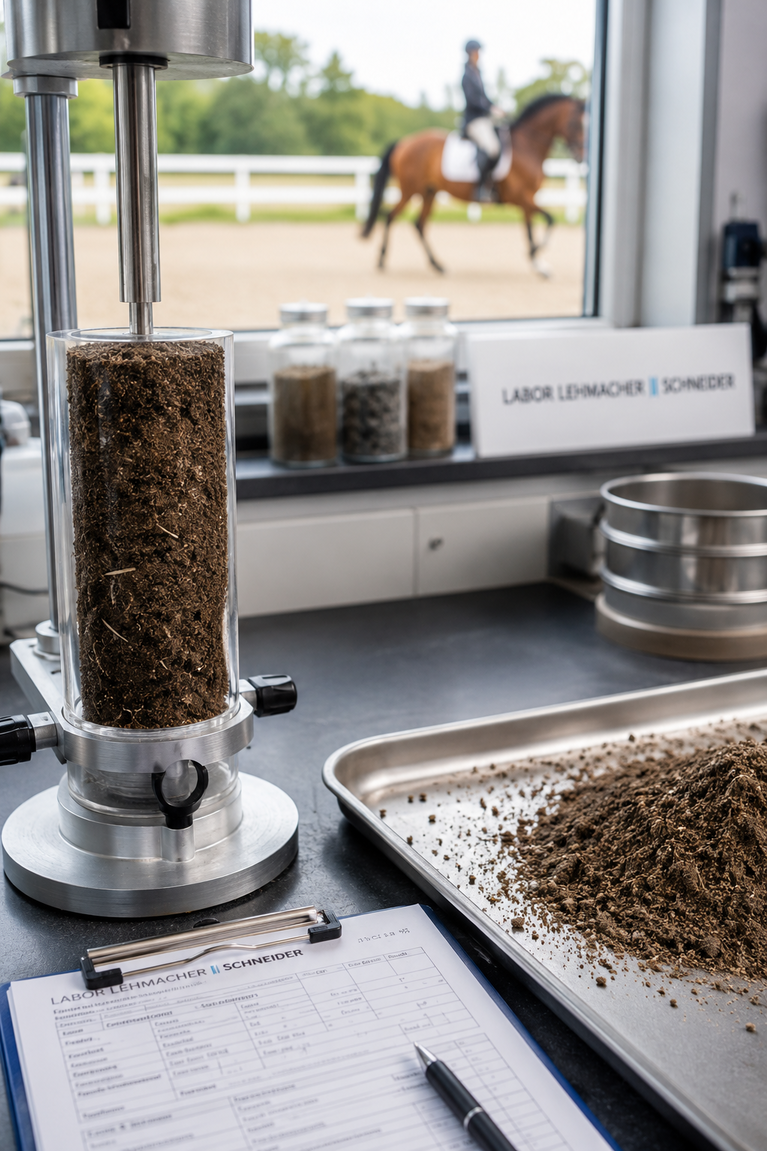
We can use measurement techniques to examine the tread resistance or penetration behavior of a tread layer, thereby providing objectively evaluable parameters.
The test can be used both to evaluate new surface layer materials and to assess existing riding surfaces.
This makes it possible, for example, to compare different materials or material mixtures with one another and to assess changes to existing riding surfaces in a transparent manner.
The analysis of tread stability is therefore a valuable tool for:
- Selecting suitable riding surface materials
- Comparing different material mixtures
- Suitability and quality testing
- Optimizing existing riding surfaces
- Root cause analysis in cases of unusual surface behavior
- Quality control and acceptance testing
04 – Water Permeability and Drainage
Water Determines Usability
A riding arena that functions reliably over the long term requires a water management system tailored to its construction and location.
Insufficient water permeability can lead to waterlogging and limited usability. At the same time, an unsuitable material composition can cause the surface layer to dry out too quickly or lose its desired properties.
We therefore examine the water permeability of the subgrade, base and filter layers, as well as the surface layer materials, depending on the specific requirements.
For existing riding arenas as well, investigations can help identify the causes of waterlogging, inadequate drainage, or other functional issues.
The FLL riding arena recommendations take into account various drainage concepts - ranging from conventionally drained riding arenas to retention areas with adjustable water levels and construction methods that rely primarily on surface drainage.
05 – Environmental and Contaminant Analyses
Using Materials Safely
When it comes to riding arena materials - and especially certain aggregates - environmental and health considerations can be just as important as technical properties.
With our contaminant and environmental analysis services, we can test materials for relevant constituents and evaluate the results based on the respective requirements.
This can be particularly useful for footing layers containing aggregates, recycled materials, or materials of unknown origin.
In this way, we combine technical material testing with chemical analysis under one roof.
06 – Quality Control During Construction
Identifying defects before they become a problem
Many defects in a riding arena do not originate solely at the surface. Deviations in materials, layer thicknesses, compaction, slope, or drainage can affect the future functionality of the entire facility.
That is why, upon request, we provide ongoing support for riding arena projects even during the construction phase.
Depending on the project, we check, for example:
- Whether the installed materials match the tested materials
- Construction and layer thicknesses
- Bearing capacity and compaction
- Levelness and slope
- Drainage
- Properties of the wearing course
- Construction of the Individual Layers
This allows deviations to be detected early on - before the next layer is installed and subsequent corrections become significantly more time-consuming.
07 – Inspection and Acceptance Testing
Independent inspection of the completed facility
Upon completion, we conduct an independent and professional inspection of the riding arena.
Depending on the construction method and the agreed-upon inspection program, the relevant technical, sporting, and safety-related properties of the facility are examined.
The inspection may include, among other things:
- Levelness
- Slope
- Layer thicknesses
- Water permeability
- Material properties
- Composition of the wearing course
- Compaction and penetration behavior
- Functionality of the riding arena structure
We document the results in a transparent manner and evaluate them professionally.
This provides builders, operators, planners, and contractors with an independent basis for evaluating and accepting the completed work.
Inspection of Existing Riding Arenas
When the riding surface no longer functions as intended
Existing riding arenas also change over time due to use, maintenance, weather conditions, and material wear.
Typical issues may include, for example:
- the surface becomes too deep or too loose
- the tread layer becomes too hard
- uneven firmness
- poor water permeability
- Waterlogging or puddling
- Excessive dust formation
- Material segregation
- Displacements within the compaction layer
- Uneven layer thicknesses
- Problems with bearing capacity or subgrade
Through targeted field and laboratory tests, we can systematically investigate the causes of such anomalies.
In doing so, we consider not only the surface but also - when necessary - the wearing course, separating course, base courses, drainage, and subgrade as an integrated system.
Based on the results, appropriate measures for optimizing or rehabilitating the area can then be determined.
Outdoor and indoor riding arenas
Our testing services can be applied to both outdoor riding arenas and indoor riding surfaces.
Among other things, we inspect riding arenas for:
- Dressage
- Show jumping
- Eventing and training
- Riding schools
- Equestrian clubs
- Private riding facilities
- Professional training facilities
- Competition and event venues
The testing program is individually tailored to the facility’s use, construction, materials, and specific requirements.
From the first test to final acceptance
Everything from a single source
An equestrian arena consists of many components - and that’s exactly how we view it.
Site investigation
↓
Testing of base and filter layers
↓
Laboratory testing of the surface layer
↓
Tread strength testing
↓
Environmental and contaminant analysis
↓
Quality control during construction
↓
Inspection and acceptance testing
↓
Testing and consulting during ongoing operation
By combining laboratory analysis, soil mechanics testing, and on-site inspections, you receive all relevant services from a single source.
Have Your Riding Arena Inspected
Are you planning a new riding arena, would you like to have a surface layer tested before installation, or are you experiencing problems with an existing facility?
We’ll tailor the testing program to your project - from the initial inspection to the final acceptance of the completed surface.